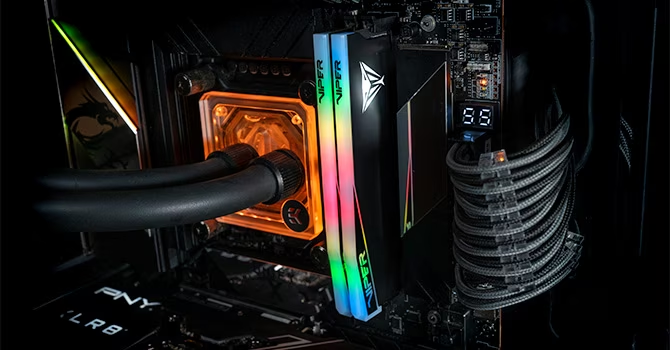
Patriot offers a diverse range of memory products, including consumer and enterprise lines, spanning various capacities and frequencies from 5200 MT/s to 9600 MT/s. Their product lines include the well-established DDR4 Viper Venom brand, the Extreme series, and the updated Elite series now available for DDR5.
In this review, focus is placed on the Patriot Elite 5 Ultra RGB DDR5-8000 48 GB (2× 24 GB) memory kit. This Elite 5 Ultra series is specifically designed to support data-heavy tasks such as generative AI and large language models, alongside supporting a general content creator’s workflow.
The review notes that the primary 8000 MT/s profile utilizes timings of 36-52-52-126 at 1.40 V, aiming to cater to most user needs without excessive demands on the hardware.
The availability of these kits currently includes three speeds: 6000 MT/s, 6400 MT/s, and 8000 MT/s, targeting both Intel and AMD users seeking enhanced performance without entering extreme overclocking territory. The kits are positioned as an improvement over Elite 5 offerings.
A consistent trend observed in benchmarks is that the 48 GB and 96 GB memory kits tend to lag behind in performance compared to smaller configurations. This regression is attributed to higher memory cell refresh times, a challenge noted across similar high-capacity non-binary kits.
The text suggests that retrieving lost performance involves memory overclocking by adjusting tRFC values, which can bring the kit’s performance up to match that of 8000 MT/s 2× 16 GB. However, users who prefer not to make BIOS manual adjustments must be aware of the shortcomings inherent in higher density memory.
Regarding compatibility with AMD platforms, the high-speed nature of this memory is generally not recommended for desktop Zen 4 and Zen 5 (non-APU) CPUs. Optimal DDR5 performance for AMD typically resides at 6000 MT/s to avoid latency issues. Attempting a 1:1 memory ratio above speeds like 6400 MT/s can cause system boot failures because current Ryzen 7000 and 9000-series CPUs lack support.
For Intel users, the kit is more likely to be beneficial, though compatibility issues persist. The memory will not function on Intel 12th Generation (K) Processors or Z690 motherboards for daily use. Furthermore, only a select few Intel Z790 motherboards are capable of supporting 8000 MT/s memory for daily use.
The article advises that achieving optimal performance and compatibility requires an Intel Arrow Lake K series CPU with enabled 200S Boost; otherwise, the increased bandwidth may not provide significant improvements over lower-frequency options. The kit is ideally suited for users possessing a 250K Plus or 270K Plus, as these CPUs are already ‘Boost enabled’ due to higher Ring Cache and default clock settings.
While high memory frequency enhances system efficiency by targeting the 1% (99th) and 5% (95th) frame rate lows, thereby minimizing stutter, the Patriot Viper Elite 5 Ultra DDR5-8000 kit contains several shortcomings. Consequently, the product is less appealing for casual gamers who do not use an Intel Ultra Plus CPU, positioning it primarily for PC enthusiasts on other platforms. The Xtreme series may be suggested as a better alternative for those focused on memory overclocking.