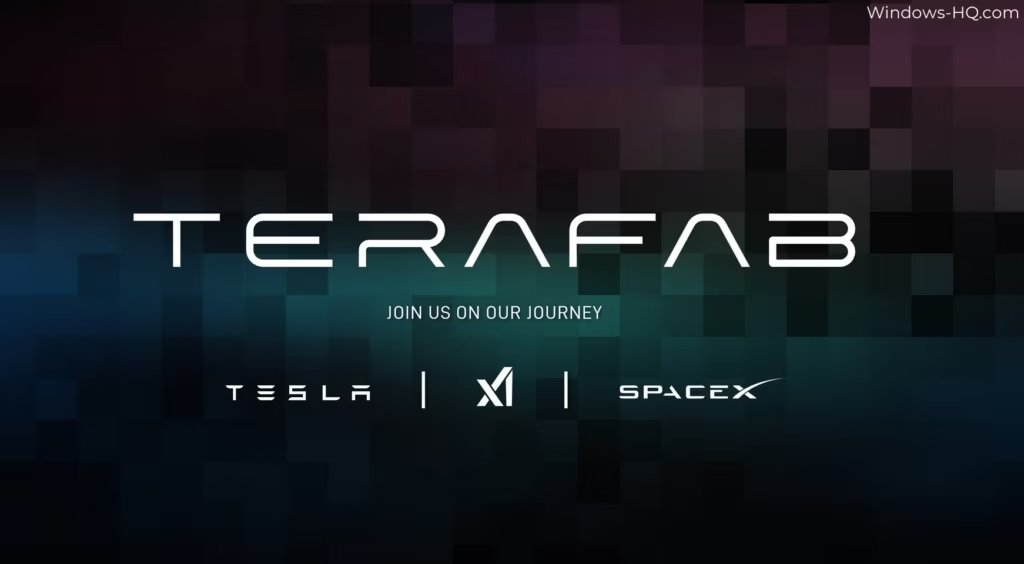
Elon Musk has announced plans to build an ambitious semiconductor manufacturing plant named “TERAFAB.” The facility will be located on Tesla’s campus in eastern Travis County, Austin, Texas. This initiative will serve as a joint effort involving three of Musk’s companies: Tesla, SpaceX, and xAI.
Musk introduced the TERAFAB project during a livestream on X. He presented the initiative as a practical solution to address the growing gap between the future chip requirements of his companies and the current pace of global chip production.
As Tesla, SpaceX, and xAI continue to expand their user bases, they require substantial computing power. Relying solely on external suppliers has been deemed insufficient for the scale of growth Musk envisions.
Currently, Tesla relies on TSMC, Samsung, and certain manufacturing and packaging capabilities from Intel to support its chip production. Through the creation of TERAFAB, Tesla, SpaceX, and xAI aim to gain more control over the entirety of the chip development process.
The planned facility is expected to integrate multiple stages of semiconductor production at a single site. These integrated processes will include logic fabrication, memory, packaging, testing, and mask production.
This consolidated setup is unusual in the semiconductor industry, as these production steps are typically spread out across multiple specialized facilities. Musk believes that integrating these processes into one location could accelerate development, allowing engineers to design, test, and revise chips with fewer delays.
The plant reportedly plans to produce two distinct chip families. The first family will focus on efficient inference capabilities, specifically designed for use in Tesla vehicles and Optimus robots.
The second chip family will be engineered for space applications. These chips will be designed to withstand the harsher conditions and higher temperatures associated with space operations.
Building this semiconductor manufacturing plant represents one of the most engineering-intensive tasks ever undertaken by Musk’s companies. Estimates place the capital expenditure for the project at $20 billion.
However, this $20 billion estimate covers only the equipment and facility construction. Semiconductor manufacturing remains expensive, technically demanding, and highly dependent on a deep pool of specialized talent that is not available in every country.
Building a competitive fab from scratch will require years of execution. A significant part of this process involves procuring specialized parts from companies such as ASML, Lam Research, KLA Corporation, and Tokyo Electron.
Securing this machinery requires long lead times, as these equipment manufacturers typically receive orders years in advance before shipping machinery to established foundries like TSMC, Samsung, or Intel. Consequently, creating the necessary supply chain for equipment, raw materials, and other components will take years before the TERAFAB project comes to fruition.