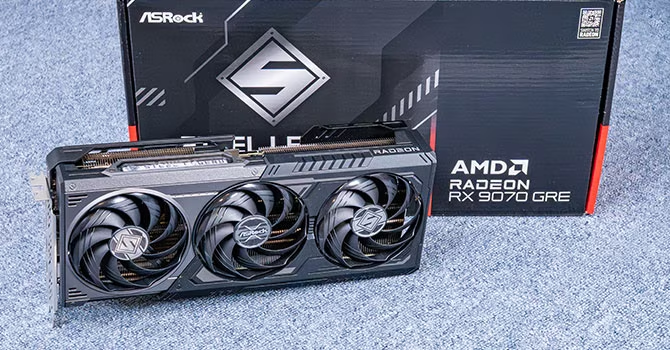
The ASRock Radeon RX 9070 GRE Steel Legend is an entry utilizing AMD’s RDNA 4 architecture, targeting the mainstream gaming segment. Originally slated as a China-exclusive product around May 2025, it is now available for global markets.
The card is powered by the Navi 48 XL GPU, featuring 3,072 stream processors across 48 RDNA 4 compute units. This configuration pairs with 12 GB of GDDR6 memory on a 192-bit bus, providing 432 GB/s of bandwidth.
The “GRE” suffix stands for “Golden Rabbit Edition,” a naming convention introduced by AMD with the RX 7900 GRE. The RDNA 4 architecture emphasizes significant improvements in ray tracing performance over RDNA 3, and it includes dedicated AI accelerators built into the compute units. These accelerators enable FSR 4, which uses on-chip machine learning hardware for upscaling, aiming to match the quality of NVIDIA’s DLSS.
In terms of specifications, the RX 9070 GRE features a lower core count (3072) compared to its direct predecessor, the non-XT RX 9070, which has 3584 cores. The card also maintains 12 GB GDDR6 VRAM and uses a 192-bit memory bus width.
The ASRock Steel Legend model features a triple-fan cooler and is powered by two 8-pin PCIe connectors. The unit achieved an impressive cooling performance, reaching only 48°C in noise-normalized testing, confirming its powerful thermal solution.
Performance testing indicates that the RX 9070 GRE at 1440p closely matches its predecessor, the RX 7900 GRE, which is expected given AMD’s restructuring of its SKU lineup and reduced core count. When compared to the RTX 5070, the GRE falls behind by a small percentage. However, it performs significantly faster than both the RTX 3080 and the RX 6900 XT, and also surpasses the RTX 5060 Ti by 28% at 1440p.
Ray tracing performance has been greatly improved with RDNA 4, matching NVIDIA in this regard. The GPU is now reported to be 6% faster than the RX 7900 GRE in RT performance.
FSR 4 requires dedicated processing cores within RDNA 4, marking a key selling point over older AMD cards. While NVIDIA maintains an advantage with DLSS due to broader game support and advanced technology stacks, FSR 4 represents a substantial effort by AMD to close the gap in image quality and frame generation capabilities.
The card’s VRAM capacity of 12 GB is noted as adequate for both 1080p and 1440p gaming. Furthermore, the RX 9070 GRE features dual VCN media engines that provide hardware acceleration for AV1, H.265, and H.264 encoding and decoding.
The card’s power consumption during gaming is stated to be around 250 W. It supports connectivity via PCI-Express 5.0 x16 and DisplayPort 2.1a UHBR13.5.