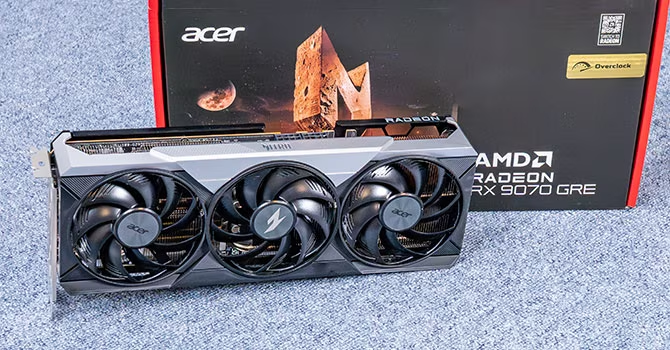
The Acer Radeon RX 9070 GRE utilizes the Navi 48 GPU, which is built on AMD’s RDNA 4 architecture. This card was originally launched as a China-exclusive product around May 2025 and now enters global markets.
The RX 9070 GRE positions itself in the mainstream gaming segment, slotting between the RX 9060 XT and the higher-tier RX 9070. It features the Navi 48 XL GPU with 3,072 stream processors across 48 RDNA 4 compute units.
The specifications include 12 GB of GDDR6 memory connected by a 192-bit bus, providing 432 GB/s of bandwidth. The ‘GRE’ suffix stands for “Golden Rabbit Edition,” a naming convention introduced with the RX 7900 GRE.
AMD highlights that RDNA 4 brings notable improvements to ray tracing performance, claiming up to twice the RT performance per compute unit compared to RDNA 3. A major focus is the integration of dedicated AI accelerators into the compute units, which power FSR 4, AMD’s upscaling technology. FSR 4 utilizes on-chip machine learning hardware and aims to close the gap with NVIDIA’s DLSS.
In performance testing at 1440p, the RX 9070 GRE matches its predecessor, the RX 7900 GRE, almost exactly. Compared to its main competitor, the RTX 5070, the GRE falls behind by a small 8%. However, it demonstrates strong performance, being about 10% faster than both the RTX 3080 and the RX 6900 XT.
The GPU’s optimal resolution is considered 1440p, though it remains a solid choice for 1080p if high refresh rates are targeted. For 4K, while possible in lighter games, utilizing upscaling and frame generation can provide an enjoyable experience.
Ray tracing performance of RDNA 4 shows considerable improvement over RDNA 3, matching NVIDIA’s performance levels to a degree. Testing confirmed the GRE is 6% faster than the RX 7900 GRE in ray tracing—a solid increase compared to pure rasterization tests.
Regarding upscaling and frame generation, AMD offers FSR 4, which requires dedicated processing cores in RDNA 4. The card supports over 300 games with support for both FSR 4 and frame generation.
Physical design-wise, the Acer Nitro model features a dual-fan cooler and utilizes two 8-pin PCIe connectors for power. Power consumption during gaming is reported to be around 250 W, with very low idle draw at just 7 W.
The pricing for the RX 9070 GRE begins “at $550.” This positions it between the RTX 5060 Ti and RTX 5070. In the AMD ecosystem, the GRE helps fill a specific performance void between the RX 9060 XT and the RX 9070 non-XT, offering 20% higher performance and more VRAM for $50 more than the alternative.