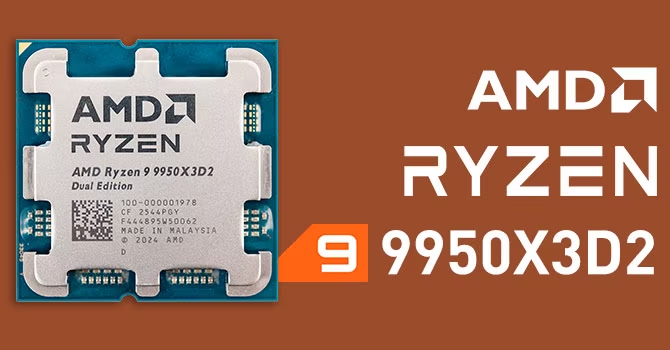
The Ryzen 9 9950X3D2 Dual Edition represents a significant technological advancement for AMD, debuting as the first desktop processor to integrate 3D V-Cache on both Compute Core Dies (CCDs). Previously, the original 9950X3D featured an asymmetric cache design—with 3D V-Cache only on one CCD. This required users to meticulously schedule games via Microsoft’s Game Bar and risked reduced performance if the detection failed.
The 9950X3D2 resolves this limitation by equipping both CCDs with 96 MB of L3 cache (a total of 192 MB). With this symmetry, every core benefits from 3D V-Cache, eliminating the former disparity between a ‘fast’ and ‘slow’ CCD.
Technically, AMD utilized the same second-generation 3D V-Cache stacking approach introduced with the 9800X3D. This inverted design allows cores to dissipate heat directly through the IHS, maintaining thermal characteristics similar to non-X3D processors.
Performance testing revealed that application performance gains are substantial. The 9950X3D2 outperforms the original 9950X3D in almost every workload, despite running at roughly 100 MHz lower clocks. This is because all threads benefit from reduced main memory accesses across all cores.
Specific productivity improvements include COMSOL physics simulation finishing 23% faster, V-Ray rendering showing a +6% gain, Ryujinx emulation increasing by 19%, and Photoshop image editing improving by 11%. ML/AI inference shows gains of +6-13%. Overall, the 9950X3D2 extends AMD’s lead over Intel’s Arrow Lake Plus refresh in productivity.
In gaming, the 9950X3D2 provides consistent performance regardless of core utilization. Unlike the original 9950X3D, there is no longer a risk associated with core placement. While the single-CCD 9850X3D may still hold a small edge due to reduced inter-CCD communication latency, the gap is minor.
Notably, Game Bar’s function becomes optional on the 9950X3D2. Because both CCDs contain 3D V-Cache, not using the Game Bar results in nearly identical gaming performance, though it leads to higher power consumption as all 16 cores remain active.
Other notable specifications include a TDP of 200 W (up from 170 W on the 9950X3D) and a default socket PPT of 270 W. AMD recommends a 360 mm liquid cooler, although air cooling can maintain temperatures below the 95°C thermal limit without throttling at base frequencies.
Regarding compatibility and setup, the processor runs on AM5 motherboards; VRMs should be able to handle the 200 W draw. The ideal memory configuration remains DDR5-6000 CL28 (1:1), as higher frequency memories require additional dividers that can reduce performance.