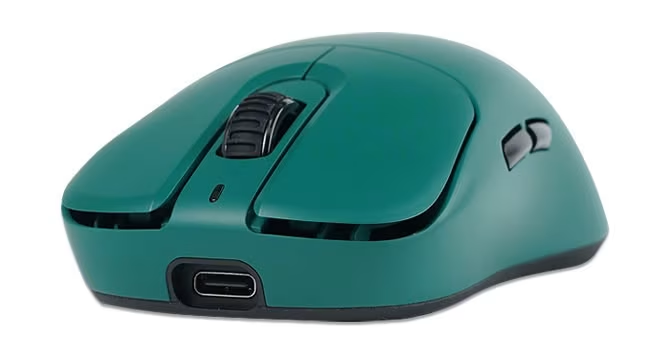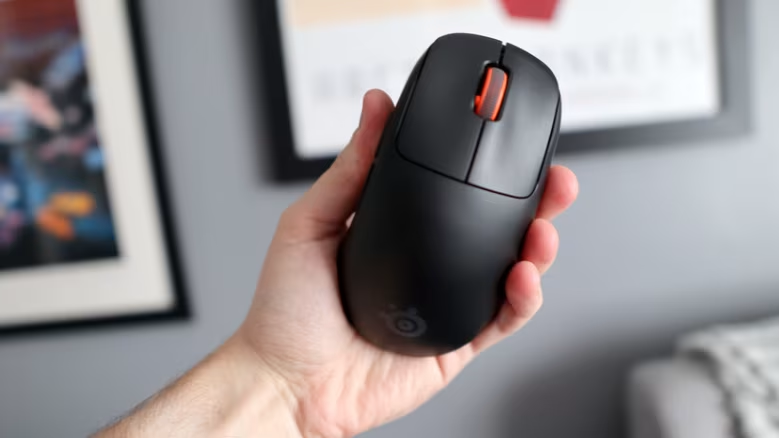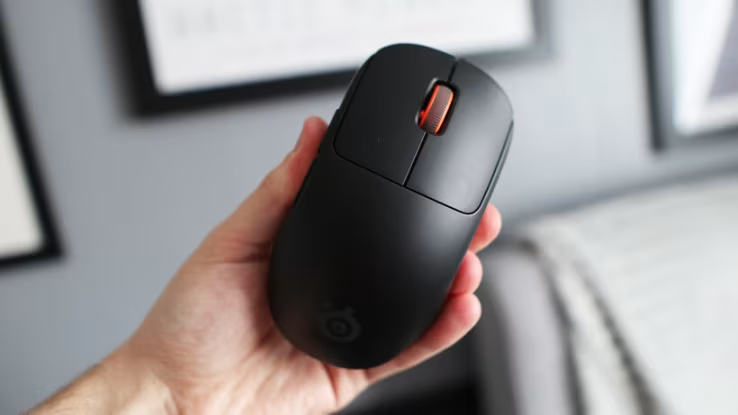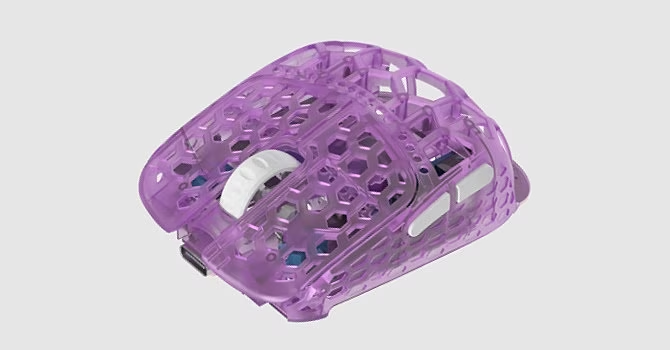
G-Wolves, a Chinese peripherals company established in 2018, has released the Fenrir Pro. This model is described as a lighter amalgamation of the Fenrir Asym and Fenrir Max. The Fenrir Pro combines structural elements from both predecessor models.
It features the symmetrical shape of the Max, while the button and hump height align with the Asym. The unit weighs 20g, which is one gram lighter than the Asym. To achieve this weight reduction, the design eliminates a bottom shell, allowing the PCB to screw directly to the top shell.
This design saves material weight and provides structural integrity, preventing rattles and flexing when side buttons are activated. The mouse uses PixArt’s PAW3950 sensor and Nordic’s latest nRF54L15 MCU. This MCU improves efficiency compared to the nRF52 series MCU found on the Asym and Max. Furthermore, the Fenrir Pro supports 8000 Hz polling rates in both wired and wireless operations. Switches utilized are Omron D2LS-21 surface-mounted switches, which were also used in the Asym. These switches are used instead of SPDT Huano switches due to size constraints.
The Pro features small hinges at the front, restricting vertical motion, resulting in a firm and snappy button response with low pre-travel and post-travel. The side buttons are also equipped with surface-mounted Omron D2LS-21 switches, maintaining very low pre- and post-travel. The scroll wheel uses a TTC encoder, which is noted for its smaller 4.5 mm size.
The mouse is available in six colors: black, white, pink, violet, Rosewater, or Clearsky. Performance testing indicated that polling stability is flawless at any polling rate. The Fenrir Pro achieves a lead of 1.2 ms over the G403 control subject in wired 8000 Hz operation, and 1.0 ms in wireless 8000 Hz operation. Additionally, the Nordic 54 series MCU significantly improves battery life compared to previous nRF52840-equipped G-Wolves releases.
Although the battery indicator is not reliable, usage suggests an expected battery life of slightly less than 20 hours at 8000 Hz, and approximately 90 hours at 1000 Hz. Configuration requires using a web driver accessible via Chromium-based browsers like Chromium or Edge.
The price of the Fenrir Pro is $159.00, matching the Fenrir Max and Asym. The report concludes that the Fenrir Pro is an improvement over both the Max and Asym, earning a Recommended status despite being expensive.