AMD is rolling out the Radeon RX 9070 GRE to the U.S. market, a GPU originally launched as a China exclusive. This card was developed on AMD’s RDNA 4 architecture and targets mainstream users at a mid-range price point.
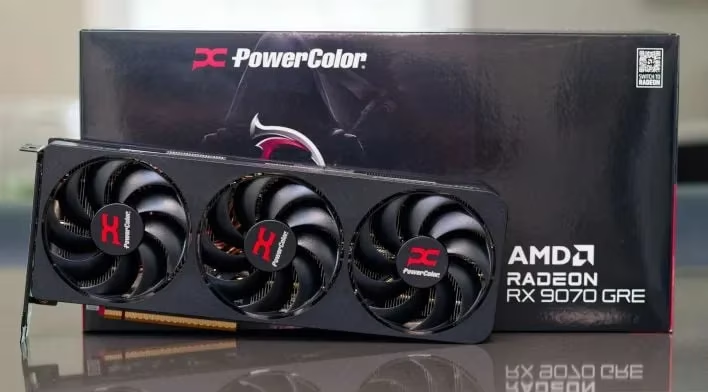
The availability of the Radeon RX 9070 GRE in the US was announced at Computex 2026. The GPU will be exclusively offered by AMD’s board partners and will come in various form factors, such as the Powercolor Reaper model tested for this article, a modest two-slot/triple fan design.
The core specifications of the card are based on the Navi 48 GPU, which utilizes TSMC’s 4nm node. While architecturally identical to other Radeon RX 9070 series cards, the GRE variant features fewer compute units and uses a narrower 192-bit interface for its 12GB of GDDR6 memory. The effective memory clock rate is noted as 18Gbps compared to 20Gbps.
AMD positions the Radeon RX 9070 GRE as a competitor to the GeForce RTX 5060 Ti, suggesting it is an optimal solution for 1440p gamers. Testing indicates that this GPU can achieve perfectly playable framerates at 1440p in many modern titles with image quality settings increased. In comparison to the 5060 Ti, the Radeon RX 9070 GRE typically outperforms it.
The card’s performance in demanding scenarios, such as those involving maximum ray tracing and graphics options in showcase titles like Black Myth: Wukong or Cyberpunk 2077, is noted to be weaker, though this can often be mitigated by reducing image quality settings or utilizing FSR.
In terms of pricing, AMD set the MSRP for the Radeon RX 9070 GRE at $549. This price matches the introductory MSRP of the more powerful 16GB Radeon RX 9070. However, current market street prices for the higher-tier 16GB Radeon RX 9070 have fallen below its own MSRP.
The article suggests that while the AMD RX 9070 GRE is competitive for 1440p gaming, buyers should be mindful of pricing. Securing a unit in the $510 range would represent a substantial reduction and could be more justifiable to consumers.