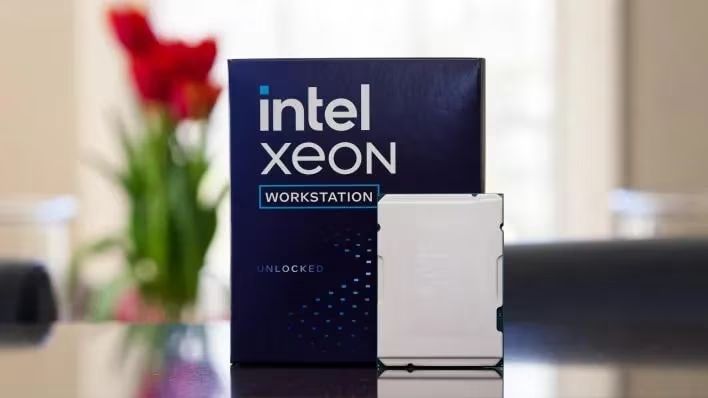
The Intel Xeon 658X brings the Granite Rapids architecture to professional workstations, offering increased CPU throughput, memory bandwidth, and higher efficiency compared to its predecessors.
The Xeon 600 series is fabricated on Intel 3, utilizing the Redwood Cove core architecture that debuted in Meteor Lake. These processors are designed to provide improvements in both performance and efficiency over older Sapphire Rapids based CPUs, while also offering higher density.
In terms of scale, the top-end flagship Xeon 698X features an impressive 86 cores, significantly outpacing previous-generation models like the Xeon x9-3595X, which had only 60 cores.
Enhancements across the series include a substantial increase in L3 cache, supporting sizes up to 336MB. Furthermore, the processors offer full support for AVX-512 and Intel’s AMX extensions.
These high-end platforms are tailored for specific professional tasks. The Xeon 600 series is noted for its suitability for AI development, workloads requiring multiple GPUs or accelerators, rendering, ray tracing, and encoding, in addition to general highly parallel AI or scientific tasks.
While powerful, the Xeon 600 series is not suitable for all use cases. Due to relatively lower clock speeds compared to the latest high-end mainstream desktop platforms, processors like the 24-core Xeon 658X often trail more affordable CPUs in single or lightly-threaded workloads.
However, when fully utilized—such as when leveraging the large cache and increased memory bandwidth of a fully loaded Xeon 385X—the platform can pull away from mainstream desktop processors. The 24-core Xeon 658X was tested against competition; while it typically trailed the 32-core Threadripper 9970X, it outperformed the 16-core Ryzen 9 9950X in multi-threaded applications intended for professional platforms.
The system cost is a significant consideration. With an MSRP of $1,699 for the 658X, the total system price—including premiums for W890-based motherboards and DDR5 RDIMMs—can be high, making it inaccessible to many users who do not benefit from its advanced capabilities.
Users considering a mainstream platform might find better value unless their workflow genuinely requires tons of IO and superior multi-threaded performance. For those whose use cases justify the massive resources available, the Xeon 600 series provides a competitive edge through increased connectivity and professional resiliency features. The processors are currently available in the channel and in full systems from partners such as Dell and Lenovo.