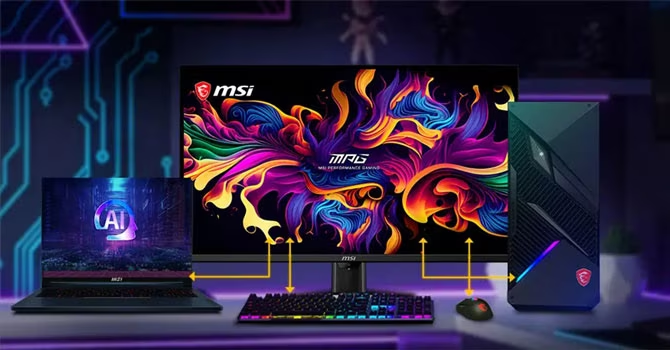
The MSI MPG 322UR QD-OLED X24 is presented as a meaningful generational upgrade that refines the concept of a 32-inch, 4K, 240 Hz QD-OLED monitor, compared to its predecessor, the MPG 322URX QD-OLED.
The key improvement centers on the adoption of Samsung Display’s latest QD-OLED panel, which utilizes the fourth generation QD-OLED technology. This newer panel offers higher full-screen brightness, improved HDR behavior, and better perceived contrast, particularly in brighter environments, while also addressing certain quirks found in earlier QD-OLED implementations.
The panel structure itself is detailed as a five-layer tandem OLED with EL Gen 3 emissive materials. This design spreads the electrical load, enabling both higher SDR and HDR brightness with reduced stress per layer. The panel retains the triangular subpixel layout characteristic of earlier QD-OLED generations. However, due to the combination of 4K resolution (3840×2160) and a pixel density of approximately 140 PPI, color fringing is described as negligible, even during extended text-heavy workloads. The resulting combination of 4K resolution and 140 PPI yields sharp text and clean interface elements.
In terms of usability and features, the monitor boasts excellent text clarity, making it genuinely suitable for mixed-use workflows—ideal for spending the day on text-heavy tasks and switching to gaming in the evening.
Color performance is rated highly in wide-gamut operation, providing complete coverage of sRGB and strong extension toward DCI-P3 and BT.2020. In native gamut mode, the display delivers the high-impact, saturated look expected from QD-OLED. When switched to sRGB mode, accuracy improves substantially, reporting an average $Delta E$ of 1.45, with grayscale $Delta E$ dropping to 1.54. Furthermore, the monitor’s usability in bright rooms improves significantly, with SDR brightness reaching 273 $text{cd/m}^2$ at maximum, compared to 202 $text{cd/m}^2$ on the previous generation.
HDR performance is also noted as improved, reaching just over 1,000 $text{cd/m}^2$ on small highlights and maintaining stronger mid-range luminance. The monitor includes a customizable Uniform Luminance feature to help fine-tune the brightness curve and reduce the jarring ABL pumping sometimes seen in standard HDR implementations.
For gaming, the MPG 322UR QD-OLED X24 is highlighted as a clear strength, featuring an average perceived response time of 1.26 ms with virtually no overshoot. This performance, paired with 240 Hz refresh rate and minimal input lag (averaging about 5.85 ms), makes it competitive for high-speed gaming.
The connectivity features include the DisplayPort 2.1a UHBR20 interface, a differentiator that delivers native uncompressed 4K at 240 Hz with 10-bit color, which is beneficial for users utilizing NVIDIA DSR/DLDSR and eliminates DSC compression artifacts.
MSI also retained several practical features from the previous model, such as a USB-C port confirmed to deliver 99.50 W of power, supporting single-cable docking. The integrated USB hub and automatic KVM switch also function reliably.
Adding to the utility is the advanced OLED Care 3.0 system, incorporating a new AI Care Sensor and customizable presence detection, which offers a wider set of burn-in prevention tools designed to operate unobtrusively during real-world use.
Overall, at a price point of $1,099, the monitor represents a strong value proposition, costing $200 less than the MPG 322URX did at launch while providing a newer panel generation, higher brightness, improved HDR certification, and additional AI features. It is positioned as an excellent option for users requiring a 32-inch 4K monitor that performs equally well across competitive gaming, HDR content viewing, and daily productivity tasks.