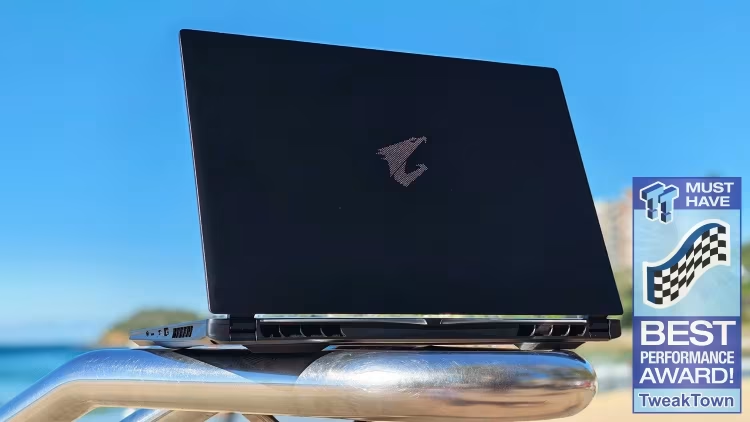
The GIGABYTE AERO X16 (EG61H) is positioned as an intriguing hybrid device, suitable for both professional creators and gamers while also functioning as a certified Copilot+ PC. It successfully incorporates typical gaming hardware into a thin chassis.
The build quality features metal lid and bottom panels paired with a smooth, soft-touch keyboard deck. The aluminum lid provides rigidity and is noted to open easily. While it lacks a full 180-degree flat hinge mechanism, this is deemed not to be a significant drawback for its intended uses of gaming and content creation.
The keyboard offers substantial customization options, including LED effects and customizable profiles. Key travel provides clean, satisfying tactile feedback, though the only disadvantages noted are the lack of a NumPad and small arrow keys. The touchpad is described as large, smooth to the touch, and possessing good precision.
For display capability, the optional 1600p unit features a 165 Hz refresh rate for vivid and crisp visuals. Out-of-the-box color accuracy is reported as well above average, making it suitable for bridging both professional work and play. However, manual calibration is recommended for professional color-critical tasks. The screen boasts 98.9% sRGB gamut coverage.
In terms of audio, the dual speakers are deemed perfectly adequate for casual media consumption or streaming movies. A “Performance” sub-mode within the Game audio preset increases footstep volume, which is advantageous for competitive online shooters like CS2 or Valorant.
The cooling system manages external temperatures effectively. While fans are audible in Performance mode, they do not generate intrusively high noise levels, allowing the sound to blend with game volume at moderate settings. The primary typing zones—the palm rests and WASD area—remain cool due to the keyboard’s function row acting as an air inlet unit. Under heavy load, only the function row of the keyboard becomes slightly warmer.
Performance-wise, the Ryzen AI 9 HX 370 processor demonstrates strong performance, outscoring the 2025 Razer Blade 16 in Cinebench 2024’s multicore benchmark thanks to high clock speeds and sustained 4.42 GHz boosts during heavy rendering tasks. This is achieved by unleashing the chip’s package power up to 75W for GIGABYTE, compared to a more conservative 45W limit found elsewhere.
The integrated RTX 5070 GPU performs surprisingly well despite being limited to an 85W TGP. The primary performance limitation across the graphics lineup is cited as the 8 GB VRAM buffer. Excellent results were achieved by utilizing DLSS for boosted frames per second (FPS).
Battery life testing showed over seven hours of viewing 4K videos on a single charge, provided the unit operated in iGPU-only or properly tuned Dynamic mode. Opting for the default 1200p screen instead of the 1600p unit could extend runtimes further.
The connectivity is robust for a crossover device, including a full-featured USB4 port, HDMI 2.1, an RJ-45 LAN port, and an audio combo jack. Additionally, using a dedicated barrel plug for power conserves valuable Type-C ports. A potential drawback noted was the inclusion of three Type-A ports, one of which is an outdated USB 2.0 port, and they do not all support fast 10 Gbps transfer speeds.
Regarding upgradeability, the machine supports two standard SODIMM RAM slots and two M.2 storage slots. The official rate for RAM is up to 64 GB (2× 32 GB), though physical limitations suggest potentially using larger modules than specified by AMD.