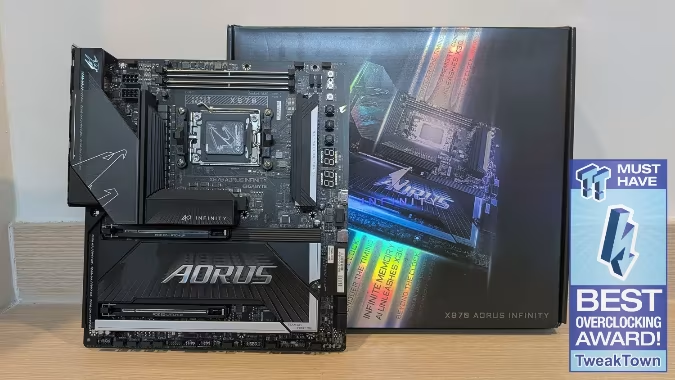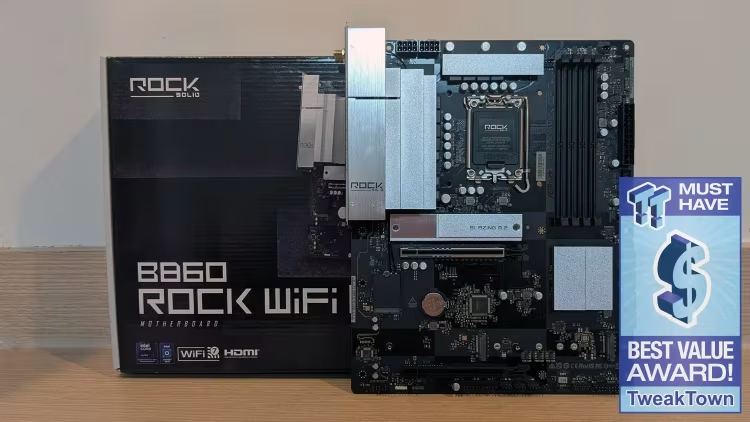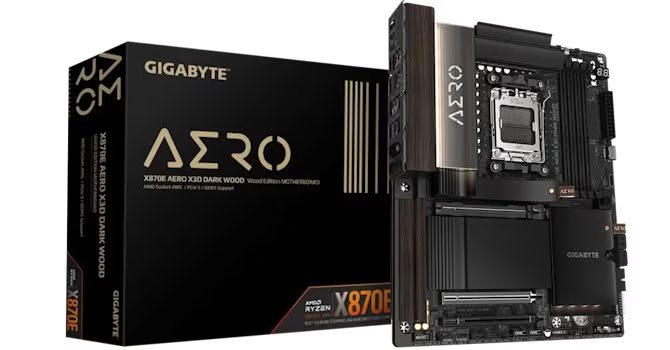
ASRock has established a strong presence in the low-end motherboard market, frequently offering good VRM temperatures and successfully cooling SSDs where more expensive boards have failed. The brand has also provided solid specifications in areas such as audio, Wi-Fi, and connectivity, contrasting with other manufacturers who may have compromised in these areas.
Notable examples of ASRock’s lower-cost offerings include the ASRock Phantom Gaming Z890 Riptide Wi-Fi and the compact ASRock Phantom Gaming B860I Lightning Wi-Fi, both of which have received industry awards.
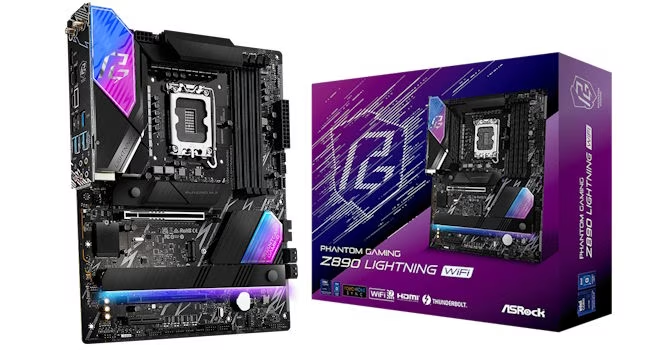
With competition cutting prices, particularly due to the launch of Arrow Lake and the fact that refresh CPUs like the Core Ultra 7 270K Plus are the last to land on LGA1851, the question is whether the Phantom Gaming Z890 Lightning Wi-Fi is a value purchase at $180, or if other Z890 options are superior.
Generally, ASRock is expected to deliver features and performance that exceed the price point at the lower end of the motherboard market, regardless of whether the platform is AMD or Intel. Furthermore, the brand’s design frequently stands out even in budget-focused segments, as seen with the purple details and RGB lighting on the Phantom Gaming Z890 Lightning Wi-Fi.
When considering the necessity of the Z890 chipset, the initial price gap between Z890 and B860 was significantly larger than it is today. However, even when the price difference was substantial, other manufacturers provided Z890 options that offered benefits—such as better Wi-Fi, audio, performance, or cooling—compared to their cheaper B860 counterparts, suggesting the need for Z890 extends beyond just overclocking ability.
The price disparity between manufacturers varies greatly, with some companies focusing on lowering the costs of premium or flagship models while neglecting lower-tier boards. For instance, the MSI MAG Z890 Tomahawk Wi-Fi was noted as offering benefits beyond overclocking that did not increase its cost significantly compared to its B860 sibling.
The Phantom Gaming Z890 Lightning Wi-Fi boasts more vCore power phases than the B860 model, which features Wi-Fi 6E instead of Wi-Fi 7, and the Z890 includes two Thunderbolt 4 ports versus one on the B860. These improvements come for a price difference of just $30, making the Z890 ultimately the better choice unless the budget is extremely restrictive.
Key benefits of the Phantom Gaming Z890 Lightning Wi-Fi include a favorable price of $180 (reduced from $250 in 2025). Specifications are strong, featuring Thunderbolt 4, Wi-Fi 7, and support for PCIe Gen 5 GPU and M.2. While it only has one M.2 slot, the integrated heatsink performs well for Gen 5 SSDs. Additionally, the VRMs maintain cooler-than-expected temperatures for such an inexpensive board. Other technical merits include tool-free M.2 heatsinks, ample fan headers and USB ports, full four-lane bandwidth for all M.2 ports, and a bonus USB 3.2 Gen 2×2 20 Gbps connection on the Type-C front panel header.
Areas needing improvement include the board’s dated EFI, which lacks features compared to the competition, and the software, although it provides reasonable fan and lighting control without excessive bloatware. Minor concerns also relate to the M.2 heatsinks being slightly fiddly.
Compared to similarly priced rivals, the Z890 Lightning Wi-Fi presents a strong balance of features. For example, the Gigabyte Z890 EAGLE WI-FI7 is noted to utilize a single USB4 port instead of a pair of Thunderbolt 4 ports, and features fewer power phases and fewer fan headers. The MSI MAG Z890 Tomahawk Wi-Fi, priced below $200, offers a better EFI and 27W fast-charging via its USB Type-C header, but it reportedly did not cool a PCIe Gen 5 SSD as well as the ASRock board.
Other competitors show rapidly diminishing feature sets at comparable price points. The $180 MSI Pro Z890-P, for instance, has ALC897 audio, fewer power phases, and only one small SSD heatsink. Similarly, the ASUS Z890 AYW Gaming Wi-Fi W possesses two fewer CPU power phases and only Wi-Fi 6, alongside inferior audio options.
Some notable high-end alternatives exist that offer compelling value additions. The Gigabyte Z890 Aorus Master was observed to be available for only $100 more than the featured board, presenting a high specification option. Ultimately, the ASRock Phantom Gaming Z890 Lightning Wi-Fi remains a strong choice, providing solid performance and features that often outperform more expensive Z890 models, making it one of the best value options if the user does not rely heavily on the EFI or expect significant software capabilities.