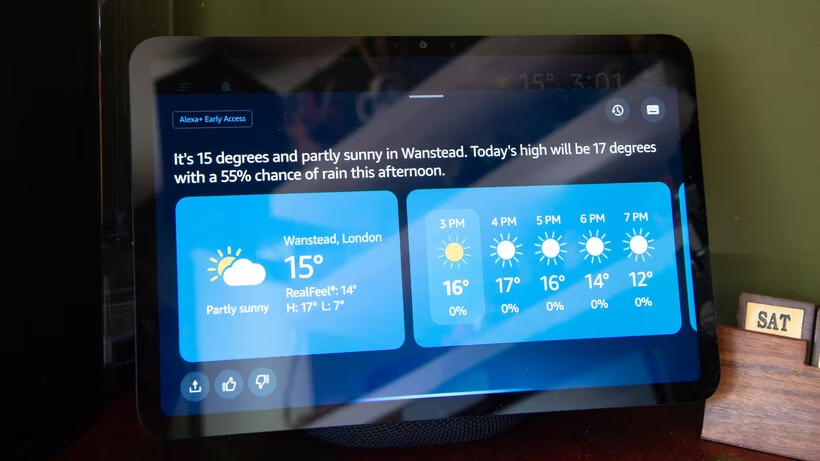
Amazon has introduced Alexa+, a new GenAI-powered voice assistant hailed as a significant upgrade over previous models. The update is described as throwing away the stilted conversations of the past, introducing a system that can better understand natural language requests.
Unlike standard Alexa, Alexa+ operates using natural conversation, eliminating the need for specific phrasing like ‘Alexa Speak.’ The replies are also more natural, and the system is capable of understanding and building context throughout a discussion. Users can ask complex questions, such as, “When’s a good day to have a BBQ?” or “Is the weather going to be consistently nice this week?” and receive sensible answers.
Key improvements include enhanced contextual understanding. Alexa+ retains listening capability after a reply, allowing for immediate follow-up questions, and permits follow-ups even after a period of silence. Furthermore, the system builds comprehensive information profiles about users, both through explicit questioning (like favorite music type) and through inference, such as learning a user’s favorite football team. This capability allows Alexa+ to adjust suggestions, such as recipes, if friends are known to be vegetarian.
In terms of general information retrieval, Alexa+ draws from a wider range of sources than standard Alexa or Siri. This allows it to answer complex queries—for instance, detailing when, where, and how train services might be affected by tube strikes.
While basic commands, such as setting alarms or turning lights on, still work, Alexa+ is smarter and makes interactions simpler. Users can give indirect commands, such as telling it that it is cold, which prompts the system to boost the heating, or saying it is dark, which can trigger the lights.
Alexa+ also functions as a powerful personal assistant due to its ability to process information from structured data, alongside email and calendar management. It can pull out information, create reminders, and schedule appointments either through the Alexa app or by sending emails to a registered address.
However, the system requires user involvement to maximize its potential. It is highly tweakable; users can correct undesirable responses, such as an overused word or an inappropriate tone, and the system learns from these inputs. Suggestions include telling Alexa+ to be brief, or requesting changes to its emotional tone.
Despite these advancements, the service has limitations. Areas requiring significant improvement include routines and local business search. When querying certain topics, such as the Spurs team on an Echo Show 11, the on-screen information may be inaccurate, referring to unrelated teams.
Furthermore, specific email services are not supported for integrating with the system, meaning users may need to create free alternative accounts. While currently available through an Early Access programme—which can be accessed by purchasing a new device or paying £19.99 a month—the service promises broader rollout to most devices.
Overall, reviews suggest that while some responses can feel forced or abrupt, the general experience marks a substantial step forward, allowing users to interact with Alexa+ more frequently and reducing the need to rely on personal phones for information.