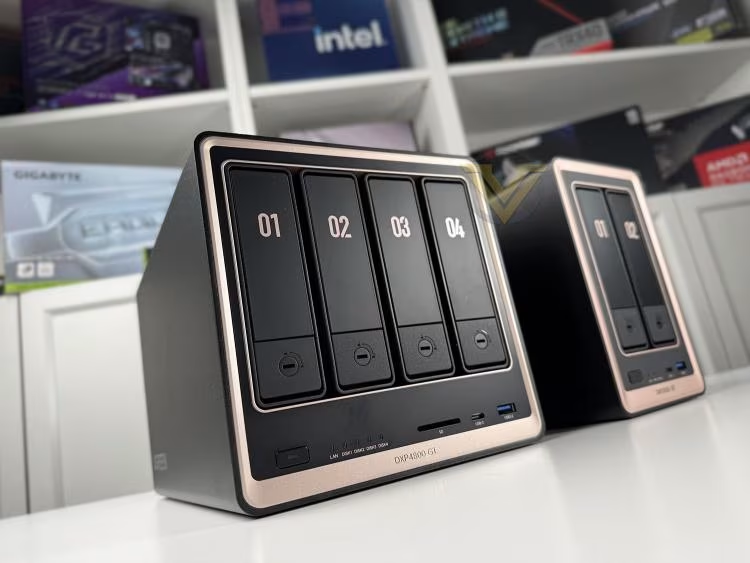
The UGREEN NASync DXP2800 GT and DXP4800 GT are new products aimed at enthusiasts, content creators, home labs, and small businesses. These units are sponsored review units from UGREEN’s new GT Series.
The DXP2800 GT is a 2-bay NAS with a maximum storage capacity of 80TB. The DXP4800 GT is a 4-bay NAS, offering a maximum storage capacity of 144TB.
Both models share a common platform. They both run on an AMD Ryzen Embedded R2514 processor, which features 4 cores and 8 threads at 3.7GHz. The system uses 8GB of DDR4 memory, which is expandable up to 64GB and is ECC-compatible.
Storage architecture for both NAS devices includes dual M.2 NVMe SSD slots operating on Gen3 standards. They also feature an HDMI output.
Power consumption under load is noted as 42W for both the DXP2800 GT and the DXP4800 GT.
The specifications vary based on the number of bays: the DXP2800 GT has two bays, while the DXP4800 GT has four bays.
Networking capabilities differ between the models. The DXP2800 GT features one 10GbE port, whereas the DXP4800 GT offers two 10GbE ports, allowing for link aggregation.
USB connectivity is consistent across both units. Both feature one USB-C port, two USB-A 10Gbps ports, and two USB-A 5Gbps ports. The DXP4800 GT also includes an additional SD card reader.
Regarding redundancy, RAID modes are supported on both devices, with the DXP4800 GT adding support for RAID 5, 6, and 10 configurations.
The physical design emphasizes premium aluminium chassis, quiet cooling, and a magnetic dust filter. The memory upgrade compartment is designed to be accessible without full disassembly.
Setup is described as intuitive. Installation involved a guided wizard covering firmware updates, account creation, storage pools, and volumes, taking only minutes. The UGOS Pro interface felt responsive and intuitive during testing.
UGREENlink remote access is supported without requiring port forwarding. The system supports Docker for self-hosted applications such as Plex, Jellyfin, Home Assistant, and Immich. While the native app catalogue is smaller than platforms like Synology DSM or QNAP QTS, Docker helps bridge this gap for technical users.
Pros noted for the products include excellent build quality, a stylish and professional design, 10GbE networking performance, superior hardware specifications compared to similarly priced rivals, easy setup, an accessible memory upgrade slot, and a two-year warranty.
Cons identified include memory initially shipping in a single-channel configuration until a second SO-DIMM is added, the M.2 slots being limited to Gen3 only (not Gen4), and the native application ecosystem trailing competitors.