Following the US and Israel’s war on Iran, which began with the killing of the country’s former supreme leader on February 28, Hezbollah reportedly began firing at Israel shortly thereafter. Israel responded to this escalation with airstrikes and a ground invasion of southern Lebanon.
The Israeli military currently occupies a strip of Lebanese land along the border, claiming the zone is necessary to protect Israel’s northern communities from Hezbollah attacks. However, this occupation has fueled concerns regarding a prolonged presence in the region.
Sweeping evacuation orders have caused hundreds of thousands of Lebanese people to flee. Many fear they will not be able to return, given the demolition of homes and ongoing Israeli attacks across southern Lebanon. These attacks persist without any apparent rebuke from the US, which previously brokered a ceasefire agreement between the Lebanese government and Israel last month.
Israel is reportedly pushing for the disarmament of Hezbollah, a militant group that has rejected such demands. Since Hezbollah is not part of the Lebanese government’s security apparatus, the group has been targeting Israeli troops within Lebanon.
Hezbollah stated it would continue its attacks on Israeli troops inside Lebanon and on towns in northern Israel as long as Israel continued its ceasefire violations. The ceasefire agreement stipulated that Israel retains a “right to take all necessary measures in self-defence, at any time, against planned, imminent, or ongoing attacks.”
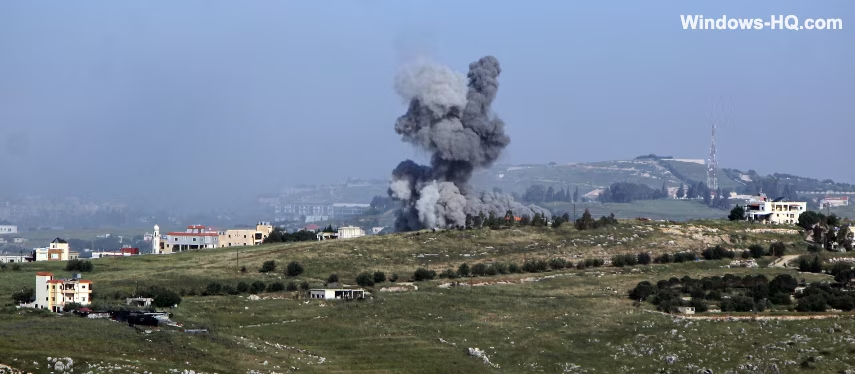
Reports indicate that despite the US-brokered ceasefire, both Israel and Hezbollah have continued their military actions, accusing each other of violations. On the morning of the reporting, an Israeli airstrike in the southern Lebanese town of Abba killed two people and injured five others. The state-run national news agency (NNA) also reported multiple Israeli airstrikes on other towns, including Yahmar al-Shaqif, Kfar Tebnit, Yahmar Arnoun, Nabatieh al-Fawqa, and Mayfadoun, alongside shelling.
Despite Israel’s claims that it only targets Hezbollah sites, the country has faced accusations of violating the ceasefire by conducting strikes that have killed civilians and continued home demolitions.
In separate developments, Iran’s judicial system reported the execution of Erfan Shakourzadeh, a 29-year-old postgraduate student from Tehran. He was hanged after being convicted for collaborating with the CIA and the Mossad. Rights groups, including Iran Human Rights and Hengaw, noted that Shakourzadeh wrote a message rejecting the charges as fabricated, and described him as an “elite student” who was allegedly subjected to torture in solitary confinement.
Meanwhile, the UK and France are set to co-host a multinational meeting of defence ministers involving 40 countries to discuss military plans aimed at restoring trade flows through the strait of Hormuz. The British defense secretary stated the goal is to ensure nations are ready to act, announcing the deployment of HMS Dragon to the Middle East for this potential mission.
This move comes as Iran warned on Sunday that it would strike British and French warships in the strait if they attempted to help reopen the strategic waterway. French President Emmanuel Macron clarified that France had never envisaged a naval deployment, suggesting a security mission would be organized in coordination with Tehran.